
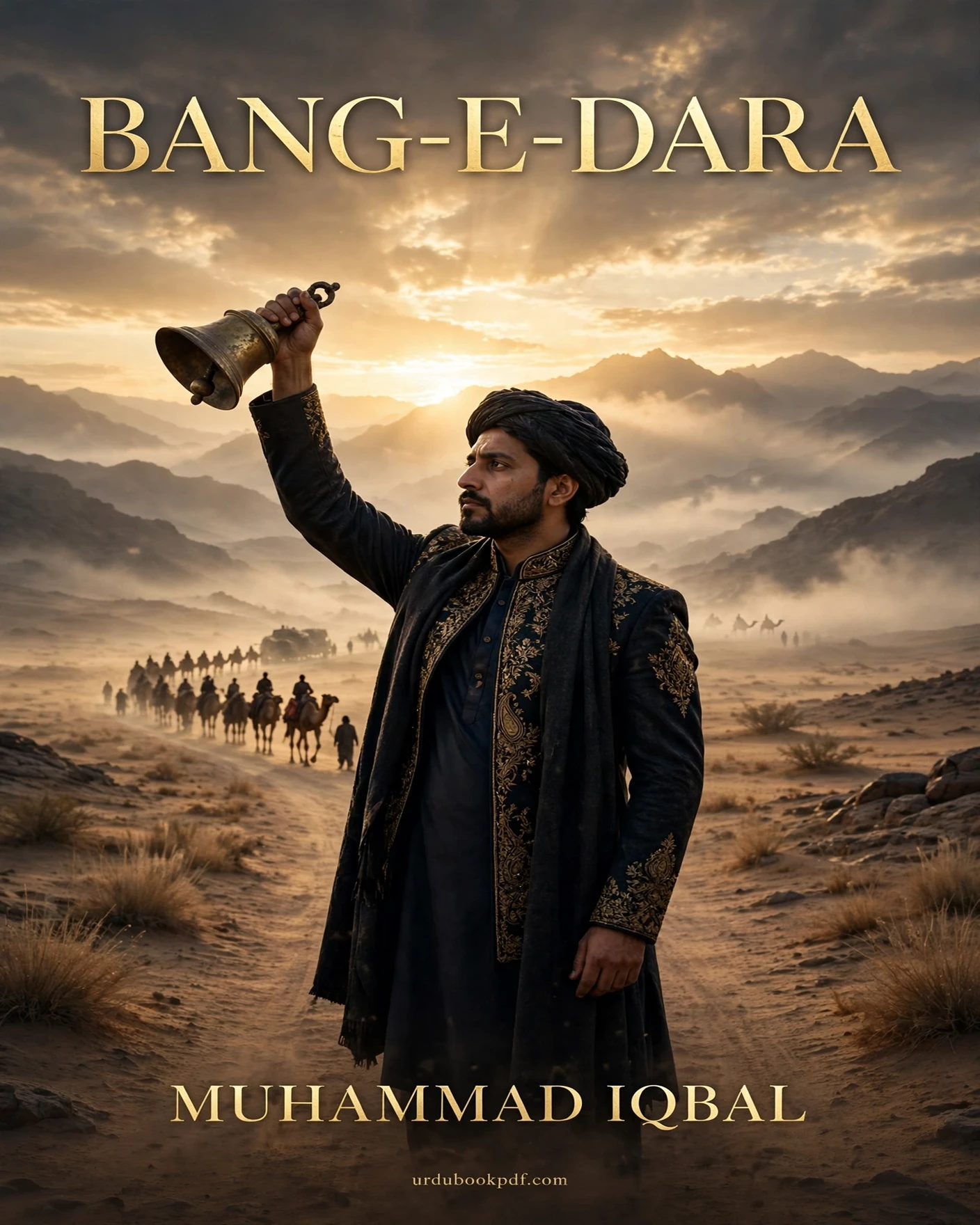
urdubookpdf.com
Bang-e-Dara by Muhammad Iqbal is one of the most important books in Urdu literature, and this page gives you the complete book to read online and download as a PDF, together with an honest, detailed guide to what the book actually is, what it contains, and why it is still read more than a hundred years after it first appeared.
Before you download anything, one fact matters more than any other.
This is not a novel.
There is no hero waiting in the next chapter, no love story unfolding toward a climax, and no plot twist to spoil.
Bang-e-Dara is Allama Muhammad Iqbal’s first published collection of Urdu poetry, and it must be read as poetry, not as a story.
That single distinction changes everything about how you should approach it, and this guide explains it plainly, so that no reader opens the book expecting a novel and closes it disappointed.
Quick Answer: Bang-e-Dara by Muhammad Iqbal is a complete collection of Urdu poems, first published in 1924, covering twenty years of the poet’s work in three parts, from early patriotic and nature poetry to the great later poems of awakening and action, including Shikwa and Jawab-e-Shikwa. It has no plot and no characters. Read it online or download the complete PDF using the buttons on this page.
Key Facts
- Form: a collection of Urdu poems, not a novel and not a story book.
- Author: Allama Muhammad Iqbal (1877 to 1938), poet and philosopher, known as the Poet of the East.
- First published: 1924, as Iqbal’s first published Urdu poetry collection.
- Structure: three parts, covering poems written up to 1905, from 1905 to 1908, and from 1908 to 1923.
- Language: Urdu, with ghazals and longer poems (nazms) in classical and modern forms.
- Most famous poems: Shikwa, Jawab-e-Shikwa, Khizr-e-Rah, and Tulu-e-Islam.
- Title meaning: The Call of the Marching Bell, the bell that wakes travellers and calls them to move on.
- Best way to read: one poem at a time, slowly, not cover to cover like a story.
- Availability: complete PDF download and read online on this page.
| Book Name | Bang-e-Dara |
| Author | Muhammad Iqbal (Allama Muhammad Iqbal) |
| Form | Urdu poetry collection, not a novel |
| First Published | 1924 |
| Poems Written Over | About twenty years, up to 1923 |
| Parts | Three parts: up to 1905, 1905 to 1908, 1908 to 1923 |
| Language | Urdu |
| Famous Poems | Shikwa, Jawab-e-Shikwa, Khizr-e-Rah, Tulu-e-Islam |
| Title Meaning | The Call of the Marching Bell |
| Availability | Free PDF Download and Read Online |
Bang-e-Dara by Muhammad Iqbal: What This Book Really Is
Bang-e-Dara is the book through which most Urdu readers first meet Iqbal, and it is also the book most often misunderstood by new readers.
People search for it as if it were a novel, because novel sites list it beside novels, and because its fame is as large as any novel’s fame.
It is nothing of that kind.
It is a poetry collection, a book of ghazals and nazms, in which each poem stands on its own and says something complete.
There are no chapters that continue a story, no hero and heroine, and no ending that resolves a plot.
Instead, there are voices, questions, complaints, prayers, and calls to action, written over twenty years, as Iqbal himself changed from a young poet of nature and patriotism into the philosopher-poet of selfhood and awakening.
Understanding that shape is the key to enjoying the book.
If you open it looking for a story, you will be confused within ten pages.
If you open it looking for one great poem at a time, you will find some of the greatest poetry ever written in Urdu.
That is why this page states the fact four times over, in the introduction, in the Key Facts, in this section, and again in the frequently asked questions below.
What Does Bang-e-Dara Mean? The Call of the Marching Bell
The title is itself a poem in miniature, and it tells you what the whole book intends to do.
Bang means a call, a cry, or a proclamation, the kind of voice that is meant to be heard at a distance.
Dara means a bell, and in the old travelling caravans of the subcontinent, a bell was rung to wake the travellers and tell them that it was time to move on to the next stage of the journey.
So Bang-e-Dara means The Call of the Marching Bell.
Iqbal chose that image deliberately, because he saw his own people as travellers who had stopped on the road, comfortable in their halt, and in danger of forgetting that a journey still lay ahead.
The book is that bell.
It does not sing its readers to sleep.
It wakes them.
Readers search for the book under several spellings, including Bang e Dara, Baang-e-Dara, Bang-i-Dara, and Baang e Daraa, and all of them point to the same 1924 collection by the same author.
The English title most often used for it is The Call of the Marching Bell, and an English translation by M. A. K. Khalil carries that title.
The Three Parts of Bang-e-Dara: Twenty Years of Poetry
Bang-e-Dara is divided into three parts, and the division is not an editor’s convenience.
It follows the real stages of Iqbal’s life and thought, and reading the parts in order is like watching a poet grow up in front of you.
The first part gathers poems written up to 1905, the year Iqbal left British India for England.
These are the poems of a young poet, and they include nursery and childhood verses, poems about nature, and patriotic verses full of love for the homeland.
The famous children’s prayer beginning Lab Pe Aati Hai Dua belongs to this early world of simple, sincere feeling, and so does the beloved patriotic song Saare Jahan Se Achha, written in 1904.
The second part covers 1905 to 1908, the years Iqbal spent as a student in Europe.
Here the poetry changes, because the poet has changed.
He admires the rationality, the discipline, and the practical energy of the West, and he says so honestly.
At the same time, he criticises what he sees as its overt materialism, its loss of spirituality, and its narrow, territorial patriotism, which he believes promises suffering rather than peace.
Readers who enjoy classic Urdu books in this reflective mood often go on to Khaak aur Khoon by Naseem Hijazi, a very different kind of classic, and the contrast between the two shows how wide Urdu literature really is.
The third part, from 1908 to 1923, is the heart of the book and the reason for its fame.
Here Iqbal speaks directly to the Muslims of India, reminding them of their past greatness, calling for a brotherhood and unity that rises above territorial boundaries, and urging a life of service to God, of sacrifice, and of action.
The message is not despair and not nostalgia.
It is that a people who remember who they were can still decide who they will become, provided they act rather than only mourn.
Love and the self run through this whole section as its deepest themes, and they lead directly into the philosophy of Khudi that Iqbal would develop further in his later work.
The Famous Poems of Bang-e-Dara, Explained at Theme Level
No summary can replace reading these poems, and this guide deliberately does not reproduce them in full.
What it can do is explain, at the level of theme, what each famous poem is doing, so that a first-time reader knows what to listen for.
Shikwa, The Complaint, first recited in 1911, is a bold and startling poem in which the poet speaks to God on behalf of the Muslims, listing their past sacrifices and asking why, after so much devotion, they now find themselves weak and humiliated.
It shocked its first listeners, because few poets had ever dared to complain to God in such direct and public terms.
Jawab-e-Shikwa, The Answer to the Complaint, recited in 1913, is the reply, in which God answers that the fault does not lie in any broken promise, but in the Muslims themselves, who have abandoned the qualities, faith, courage, action, and unity, that once made them great.
Read together, the two poems form a single argument, and that is why they must never be read apart.
Khizr-e-Rah, Khizr the Guide, takes its name from Khizr, the mysterious guide of Islamic tradition, and uses that figure to reflect on the journey of peoples and civilisations, on why some rise and others fall, and on what guidance means when the road ahead is dark.
Tulu-e-Islam, The Rise of Islam, is a poem of dawn and hope, looking toward a renewal of Islamic civilisation, not through dreaming about the past, but through the hard work of the present.
Around these great poems stand the ghazals of the collection, shorter, more personal, and often more tender, in which love, longing, and the inner life of the self are explored in the classical ghazal form.
The Themes of Bang-e-Dara: Selfhood, Action, Unity, and Awakening
Five great themes run through Bang-e-Dara, and together they explain why the book is still quoted in speeches, classrooms, and everyday conversation.
The first is Khudi, selfhood, the idea that every human being carries a hidden strength, talent, and dignity, which must be discovered, trained, and realised through love and perseverance, rather than left asleep.
Iqbal would later make Khudi the centre of his philosophy, but its seeds are already alive in Bang-e-Dara.
The second theme is action over despair.
Again and again, Iqbal refuses the comfort of blaming fate, history, or others, and insists that a people, like a person, becomes what it repeatedly does.
The third theme is unity beyond narrow boundaries.
The book calls Muslims to a brotherhood that is not limited by province, language, or territory, and its argument is moral before it is political.
The fourth theme is the honest encounter with the West, admiring its science and discipline while refusing its materialism and its worship of power.
The fifth theme is the dignity of youth.
Iqbal speaks to the young as the carriers of the future, and his most famous calls are addressed to them, because he believed that a nation’s future is decided by what its young people choose to love.
That same concern for character and choice runs through Manto Nama by Saadat Hasan Manto, a Partition-era classic whose readers often come to Iqbal looking for the ideas behind the history.
About the Author: Muhammad Iqbal (1877 to 1938)
Muhammad Iqbal, universally known as Allama Iqbal, was born on 9 November 1877 in Sialkot, in Punjab, and died on 21 April 1938 in Lahore.
He was a descendant of a Kashmiri Brahmin family that had embraced Islam in the seventeenth century, a background that gave him an unusually wide sense of South Asian history from the very beginning.
After a traditional education in Arabic, Persian, and Urdu, he studied at Government College Lahore, then travelled to England, where he studied at Cambridge and qualified as a barrister at Lincoln’s Inn, and to Germany, where he earned a doctorate in philosophy from Munich University.
He was therefore, at once, a poet of the classical Eastern tradition and a philosopher trained in the modern Western university, and Bang-e-Dara is the book where those two educations first meet in full.
He wrote in both Persian and Urdu, and he is often called the Poet of the East and the poet-philosopher of the Indian subcontinent.
His public life mattered as much as his poetry.
He was a thinker whose ideas about Muslim identity, selfhood, and political future shaped the debates of his time, and his birthday, 9 November, is still observed as Iqbal Day in Pakistan.
For a different window on the same literary tradition, many readers also explore Dil Se Niklay Hain Jo Lafz by Farhat Ishtiaq, which shows Urdu prose at its most observant and humane.
Who Should Read Bang-e-Dara? And How to Read a Poetry Collection
Bang-e-Dara is for any reader who loves Urdu, for students of Urdu literature, for readers preparing for examinations in which Shikwa and Jawab-e-Shikwa appear, and for anyone who has heard Iqbal quoted all their life and wants to meet the poems themselves.
It is also for readers who do not read Urdu fluently but want to understand why Iqbal matters, because the themes, once explained, open the door to translations and commentaries.
The best method is simple.
Read one poem a day, or even one poem a week, and read it twice.
On the first reading, follow the feeling and the images, and do not stop at every difficult word.
On the second reading, look up the words you missed, and ask what the poem is arguing, not only what it is describing.
Keep a small notebook for lines that stay with you, and return to them, because Iqbal’s lines have a way of meaning more on the tenth reading than on the first.
Students should pay special attention to Shikwa and Jawab-e-Shikwa as a pair, to the three-part structure of the book, and to the meaning of the title, because examiners return to those three points again and again.
Bang-e-Dara and Iqbal’s Other Books: Do Not Confuse Them
One of the commonest confusions about Iqbal is the mixing up of his books, and this section exists to prevent it.
Bang-e-Dara, published in 1924, was his first published Urdu poetry collection.
It is not his first book overall, because his Persian philosophical poem Asrar-e-Khudi, The Secrets of the Self, had appeared in 1915, followed by Rumuz-e-Bekhudi, The Secrets of Selflessness.
Those Persian works are different books, in a different language, and they do not count as Bang-e-Dara.
After Bang-e-Dara came his later Urdu collections, Baal-e-Jibreel, Gabriel’s Wing, in 1935, and Zarb-e-Kaleem, The Rod of Moses, in 1936.
Armaghan-e-Hijaz, The Gift of Hijaz, appeared after his death in 1938.
Kulliyat-e-Iqbal is not a separate book of new poems, but a collected edition bringing his Urdu poetry together, and it must not be confused with Bang-e-Dara itself.
A reader who wants Iqbal’s earliest Urdu voice, from childhood prayer to the great poems of awakening, wants Bang-e-Dara.
A reader who wants his later, more philosophical Urdu ghazals wants Baal-e-Jibreel and Zarb-e-Kaleem.
That same care about telling books apart matters across Urdu literature, and readers of Zarguzasht by Mushtaq Ahmad Yousufi will recognise how much a single author’s collected work can differ from one volume to the next.
Why Bang-e-Dara Still Matters Today
A hundred years after its publication, Bang-e-Dara is still quoted because its questions have not gone away.
Every generation of readers finds itself asking the same questions Iqbal asked, why a people with a great past feels weak in the present, what it means to borrow from another civilisation without losing oneself, and whether young people will choose comfort or courage.
The book’s answer is demanding, and that is part of its power.
It does not flatter its readers.
It tells them that renewal begins with the self, and that no slogan, no nostalgia, and no complaint, however eloquent, can substitute for action.
That message speaks as clearly to a student, a worker, or a parent today as it spoke to its first readers in 1924.
How to Read Bang-e-Dara Online and Download the Complete PDF
The complete book is available on this page through the Read Online and Download PDF buttons.
Use Read Online if you want to begin at once in your browser, without saving a file.
Use Download PDF if you want to keep the complete book on your phone or computer, to read offline, to mark, and to return to poem by poem.
Both buttons point to the same complete book file supplied for this page.
If you are a student, keep the PDF beside your notes on the three parts of the book, so that every poem you study can be placed in its period at once.
And if you are building a small library of Urdu classics, Aangan by Khadija Mastoor is a natural next book after Iqbal, offering prose reflections to set beside his poetry.
No payment and no sign-up is needed to use the buttons on this page.
Frequently Asked Questions About Bang-e-Dara
Is Bang-e-Dara a novel?
No. Bang-e-Dara is a collection of Urdu poems by Muhammad Iqbal, not a novel. It has no plot, no hero, and no heroine. It is a book of ghazals and nazms, and each poem stands on its own.
Who wrote Bang-e-Dara?
Allama Muhammad Iqbal wrote Bang-e-Dara. He was born in Sialkot in 1877 and died in Lahore in 1938, and he is known as the Poet of the East.
When was Bang-e-Dara first published?
Bang-e-Dara was first published in 1924. It was Iqbal’s first published Urdu poetry collection, gathering poems written over about twenty years up to 1923.
What does Bang-e-Dara mean?
Bang-e-Dara means The Call of the Marching Bell. Bang means a call, and Dara means a bell, the bell rung to wake travellers in a caravan and call them to move on. The book intends to wake its readers in the same way.
What are the three parts of Bang-e-Dara?
The first part covers poems written up to 1905, including childhood, nature, and patriotic verses. The second part covers 1905 to 1908, the years Iqbal spent studying in Europe. The third part covers 1908 to 1923, and contains the great poems of awakening, including Shikwa and Jawab-e-Shikwa.
Are Shikwa and Jawab-e-Shikwa part of Bang-e-Dara?
Yes. Both Shikwa, first recited in 1911, and its reply, Jawab-e-Shikwa, recited in 1913, are part of Bang-e-Dara. They should always be read together, because the second poem answers the first.
What is Khizr-e-Rah about?
Khizr-e-Rah, Khizr the Guide, is a reflective poem named after Khizr, the guide of Islamic tradition. At theme level, it reflects on the journey of peoples and civilisations, on rise and fall, and on what guidance means when the road ahead is uncertain.
What is Tulu-e-Islam about?
Tulu-e-Islam, The Rise of Islam, is a poem of dawn and hope. At theme level, it looks toward the renewal of Islamic civilisation through the hard work and action of the present, not through dreaming about the past.
Is Bang-e-Dara the same as Baal-e-Jibreel or Zarb-e-Kaleem?
No. Baal-e-Jibreel, published in 1935, and Zarb-e-Kaleem, published in 1936, are Iqbal’s later Urdu collections, and they are different books. Armaghan-e-Hijaz appeared after his death in 1938. Kulliyat-e-Iqbal is a collected edition, not a separate new book.
How many pages does Bang-e-Dara have?
Page counts differ between editions, because print layouts, font sizes, and bindings differ. This page therefore does not present a single page count as a settled fact. The complete book file available here is the full collection, whichever edition’s layout it follows.
Is there an English version of Bang-e-Dara?
Yes. Bang-e-Dara is widely known in English as The Call of the Marching Bell, and an English translation by M. A. K. Khalil carries that title. Readers who do not read Urdu can begin with a translation, and then return to the Urdu poems with a commentary.
How can I read Bang-e-Dara online or download the PDF?
Use the Read Online and Download PDF buttons on this page. They point to the complete book file supplied for this page, and both options give you the full collection.
How should a beginner start reading Bang-e-Dara?
Begin with one famous poem, such as Shikwa together with Jawab-e-Shikwa, read it twice, and then rest with one or two ghazals. Do not try to finish the book in one sitting. One poem a day, read slowly, is the method the book itself rewards.
Why is Bang-e-Dara still famous after a hundred years?
Because its questions are still alive. Its themes of selfhood, action, unity, and honest encounter with the modern world speak to every new generation, and its poetry carries those themes in images that are remembered long after lectures are forgotten.
Final Verdict: Should You Read Bang-e-Dara?
Yes, without hesitation, provided you read it for what it is.
If you want a novel, this is not your book, and no honest page should pretend otherwise.
If you want poetry that wakes you, argues with you, and stays with you for years, then Bang-e-Dara is one of the very few books in Urdu that you cannot afford to miss.
Begin with Shikwa and Jawab-e-Shikwa, learn the meaning of the title, follow the three parts in order, and let one poem a day do its slow work.
A hundred years of readers have done exactly that, and the bell has not stopped ringing yet.


