
urdubookpdf.com
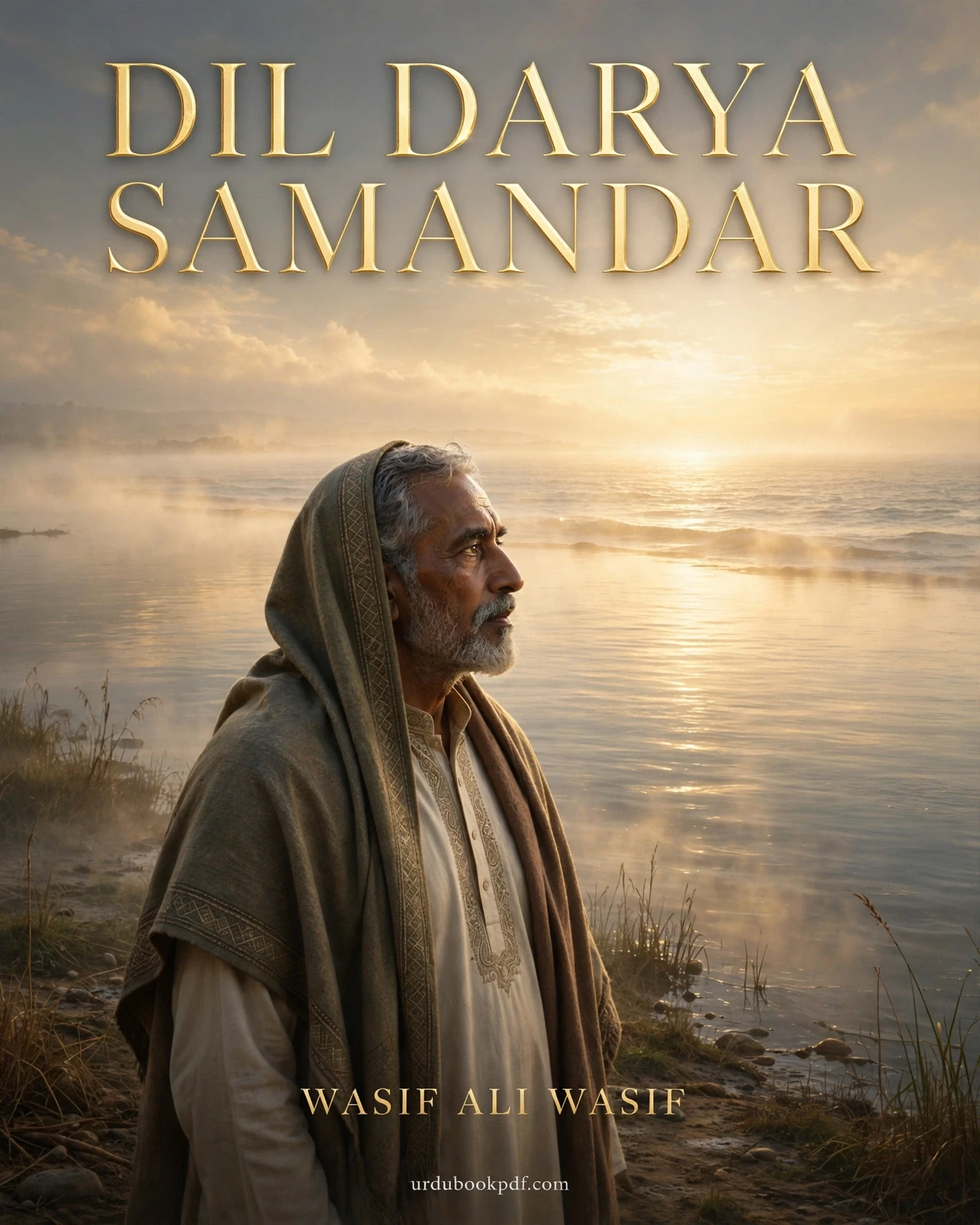
Dil Darya Samandar by Wasif Ali Wasif is one of the most loved spiritual books in Urdu, and this page gives you the complete book to read online and download as a PDF, together with an honest guide to what the book actually is, what it contains, and why readers return to it again and again.
Before you download anything, one fact matters more than any other.
This is not a novel.
There is no hero waiting in the next chapter, no love story unfolding toward a climax, and no plot twist to spoil.
It is a collection of short essays and reflections, written in simple, luminous Urdu, and it is meant to be read slowly, one piece at a time.
The title itself is the best introduction.
Dil means the heart, Darya means a river, and Samandar means the ocean.
Wasif Ali Wasif uses that journey, from heart to river to ocean, as the image of a human life growing deeper, wider, and closer to the Divine.
Readers search for this book under several spellings, including Dil Darya Samundar and Dil Dariya Samandar, and all of them point to the same book by the same author.
Quick Answer: Dil Darya Samandar by Wasif Ali Wasif is a complete collection of short Urdu essays and spiritual reflections, gathered from the author’s newspaper columns, on love, faith, human nature, life, and death. It has no plot and no characters. Read it online or download the complete PDF using the buttons below.
Key Facts
- Form: a collection of short essays and reflections, not a novel.
- Author: Wasif Ali Wasif (1929 to 1993), teacher, writer, poet, and Sufi intellectual.
- Origin: essays first written as columns for the Urdu daily Nawa-i-Waqt, then gathered into book form.
- Language: Urdu, in a famously simple and clear style.
- Title meaning: The Heart, the River, the Ocean.
- Best way to read: a few pages at a time, in any order, not cover to cover like a story.
- Availability: complete PDF download and read online on this page.
| Book Name | Dil Darya Samandar |
| Author / Writer Name | Wasif Ali Wasif |
| Form / Genre | Short essays and spiritual reflections (not a novel) |
| Origin | Nawa-i-Waqt columns, gathered into book form |
| Language | Urdu |
| Title Meaning | The Heart, the River, the Ocean |
| Also Searched As | Dil Darya Samundar, Dil Dariya Samandar |
| Status | Complete book |
| Availability | Free PDF Download and Read Online |
✅ Complete PDF Download
Dil Darya Samandar by Wasif Ali Wasif: What This Book Really Is
The first thing to understand about Dil Darya Samandar is what kind of book it is, because most download pages get this wrong.
It is filed on many websites under Urdu novels, and a few shop listings even describe it as a book of poetry.
Neither label is accurate, and both set the reader up for disappointment.
Dil Darya Samandar is a collection of short essays and reflections in prose.
There is no hero and no heroine.
There is no storyline that moves from a first chapter to a last chapter.
There is no twist waiting at the end, and there is nothing to spoil.
Instead, each piece stands on its own, a few pages of thought on one subject, written to be read, put down, and thought about.
That is exactly why the book has lasted.
A novel is finished once and remembered as a story, but a book of reflections is returned to again and again, at different ages, for different problems.
Wasif Ali Wasif did write poetry as well, and his ghazals and couplets are listed separately in Urdu literary records.
This book, however, is not that poetry.
It is prose, in the plain and musical Urdu for which he is famous.
The critic and scholar Professor Gilani Kamran praised the book for what he called the pleasant rhythm of an emotionally sustained prose.
That description is worth keeping in mind, because it captures the reading experience better than any category label.
You do not race through Dil Darya Samandar.
You sit with it, one reflection at a time, and its rhythm does its work quietly.
What Does Dil Darya Samandar Mean? The Heart, the River, the Ocean
The title is the best introduction to the whole book, and it is worth translating word by word.
Dil means the heart.
Darya means a river.
Samandar means the ocean.
In English the title is usually rendered as The Heart, the River, the Ocean, and an English edition under that very title is also listed online.
The three words describe a journey, not three separate things.
A heart that only holds love for itself stays small.
A heart that lets love flow outward becomes a river.
A heart that gives without counting becomes as wide and deep as an ocean.
That is the central image of Wasif Ali Wasif, and almost every reflection in the book returns to it in one form or another.
Readers search for this book under several spellings, including Dil Darya Samundar and Dil Dariya Samandar.
All of them point to the same book by the same author.
The spelling used on this page, Dil Darya Samandar, is the one most commonly used in book listings, and it is the spelling used in the title and web address of this page.
What Is Inside Dil Darya Samandar? Themes and Subjects
Because the book has no plot, the honest way to describe its contents is by its subjects.
The reflections circle the great questions of ordinary life: love, faith, and spirituality above all, and then human nature, life and death, hope and fear, prayer, happiness and sorrow, fortune, expectation, and promise.
These are the subjects Wasif Ali Wasif returned to throughout his writing, and in this book he treats them in his shortest and most concentrated form.
No single piece demands a long sitting.
Each one offers one clear thought, stated simply, and then leaves the reader to carry it into the day.
The style is the reason the book reaches readers who never read philosophy.
Wasif Ali Wasif wrote in simple Urdu that an ordinary reader can follow without a dictionary and without a teacher.
The sentences are short, the images are drawn from everyday life, rivers, hearts, doors, journeys, and the meaning is never hidden behind difficult words.
At the same time, the thoughts are not shallow.
A short reflection on expectation, for example, can change how a reader understands a disappointment that has troubled him for years.
That combination, simple language with deep meaning, is why his books are still quoted in conversations, in sermons, and on social media decades after his death.
How Dil Darya Samandar Was Written: From Newspaper Columns to a Book
Dil Darya Samandar did not begin as a book planned on a desk.
Wasif Ali Wasif was a regular columnist for the Pakistani Urdu daily Nawa-i-Waqt, and his short essays first reached readers as newspaper columns.
During his lifetime, most of those columns were gathered, under titles chosen by himself, into two books: Dil Darya Samandar and Qatra Qatra Qulzam.
A third collection, Harf Harf Haqeeqat, was published after his death in 1993.
Knowing this origin explains the shape of the book.
It reads like a series of short, complete pieces because that is what it originally was, one thoughtful column at a time, written for ordinary readers of a daily newspaper.
One caution is needed about dates, because online listings disagree with each other.
A recent survey of his thought dates Dil Darya Samandar to 1987, while other listings give no year at all or describe the book only as a collection of his columns.
This page therefore does not present a single first-publication year as a settled fact.
What is certain is the origin: newspaper columns written during his lifetime, gathered into book form, and read ever since as one of his most loved collections.
His very first book of aphorisms, Kiran Kiran Sooraj, had already appeared in 1985 and remained a bestseller for many years, which shows how ready his readers were for this kind of short, wise writing.
About the Author: Wasif Ali Wasif (1929 to 1993)
Wasif Ali Wasif was born on 15 January 1929 in Khushab, Punjab, and he passed away on 18 January 1993 in Lahore, Pakistan.
By profession he was a teacher, and by calling he was a writer, a poet, and a Sufi intellectual.
He is famous for a literary style unlike anyone else in Urdu: short, clear, and deeply spiritual, with the power to state a large truth in a few lines.
About forty books are credited to him, including collections of aphorisms, essays, poetry, and the long series of conversations known as Guftagu.
His other well known titles include Shab Chiragh and Baat Se Baat, and his work remains a staple of Urdu spiritual reading in Pakistan and among Urdu readers worldwide.
What made him different was not only what he wrote but whom he wrote for.
His readers were not only scholars and students of literature.
They were ordinary people looking for guidance on how to live: how to love without selfishness, how to bear sorrow without bitterness, how to keep faith in a busy and materialistic world.
He answered them in their own language, without jargon and without showing off.
That is why his books are still gifted at weddings, kept beside beds, and quoted by people who may never read another book of philosophy in their lives.
Who Should Read Dil Darya Samandar? And How to Read It
This book is for anyone who wants wisdom in small, daily portions rather than a long story.
It suits readers who feel rushed or weighed down by a materialistic world, students of Urdu literature who want to understand Wasif Ali Wasif at his most accessible, and older readers who have lived enough to recognise the truths he states so simply.
It is also an ideal first book for anyone new to his work, because no background knowledge is needed and any page can be the first page.
Readers who love classic Urdu prose that rewards slow reading often keep this book beside Zarguzasht by Mushtaq Ahmad Yousufi, another great Urdu classic that is best enjoyed a little at a time rather than in a hurry.
It is equally important to say who should look elsewhere, at least for now.
If you want a romantic novel with a hero, a heroine, and a story that moves toward a wedding or a separation, this book will not give it to you, and you will only be frustrated.
The honest way to read Dil Darya Samandar is to read one or two reflections a day, preferably in a quiet moment, and to let each one stay in your mind before moving on.
Many readers keep it where they can open it at random, trusting that the page they open will speak to the day they are having.
That is not a weakness of the book.
It is the way the book was designed to be used.
Dil Darya Samandar and Wasif Ali Wasif’s Other Books
Once you have tasted Dil Darya Samandar, the natural next step is his other short works, and it helps to know how they fit together.
Kiran Kiran Sooraj, his first book of aphorisms from 1985, is even shorter in form, single lines and short sayings that shine like its title, which means ray upon ray of sun.
Qatra Qatra Qulzam, the companion volume to this book, gathers more of the same newspaper columns, drop by drop becoming an ocean, as its title suggests.
Harf Harf Haqeeqat, published after his death, continues the same project word by word, truth by truth.
The Guftagu series, by contrast, records conversations and questions from his readers, and shows the teacher answering real people in real words.
For readers building a serious shelf of Urdu literature, the step after Wasif Ali Wasif is often toward the great Urdu novels themselves.
Khadija Mastoor Aangan by Khadija Mastoor is one of the finest places to go next, a novel of a household and a changing world that rewards the same patient, thoughtful reading.
The contrast is instructive: where Wasif gives you a single thought to carry all day, Mastoor gives you a whole world to live in for weeks.
Both belong on the same shelf, and both repay the reader who does not rush.
Why Dil Darya Samandar Still Matters Today
It is fair to ask why a book of short reflections from decades ago still finds new readers every year.
The answer is that the problems it addresses have not changed.
The modern human condition it describes, a heart once open to love, empathy, and higher knowledge, now estranged from those capacities by a fast and materialistic life, is more familiar today than when the columns were first written.
People still ask the same questions: how to love truly, how to face death, how to keep hope when fortune turns, how to pray with sincerity, how to live without being owned by things.
Wasif Ali Wasif answers those questions without preaching and without anger, as a companion walking beside the reader rather than a lecturer above him.
That staying power is shared by the serious books of Urdu literature generally.
Books that ask for slow, thoughtful reading survive for the same reason, which is why readers still return to Naseem Hijazi Khaak aur Khoon by Naseem Hijazi, a historical novel that also refuses to be read in a hurry and also speaks about sacrifice and the price of what we love.
The subjects are different, but the reading habit is the same: patience, attention, and a willingness to be changed by a book rather than merely entertained by it.
In a time of endless scrolling, that habit is itself a kind of wisdom.
How to Read Dil Darya Samandar Online and Download the Complete PDF
Use the buttons on this page to read Dil Darya Samandar online or download the complete PDF.
The buttons point to the full book file supplied for this page, so you can start reading at once on a phone or a computer, and keep the PDF for offline reading later.
One practical note will save confusion: different editions and scans of this book show different page counts.
A current hardcover listing shows 192 pages, a popular PDF listing shows 303 pages, and an older online scan shows 124 pages.
Those numbers describe different editions and layouts, not different books, so judge completeness by the content, not by the page number on the file you open.
If you prefer a printed copy, bookshops in Pakistan stock Wasif Ali Wasif titles regularly, though individual editions go in and out of stock, and the PDF remains the easiest way for most readers to reach the full text.
If you want a very different kind of Urdu classic after this contemplative book, Saadat Hasan Manto Manto Nama by Saadat Hasan Manto offers the opposite experience: short, fierce, and unsparing prose from a writer who looked at society without flinching.
The two authors could hardly be more different, and reading them together shows the full range of what Urdu prose can do.
Frequently Asked Questions About Dil Darya Samandar
Is Dil Darya Samandar a novel?
No. It is a collection of short essays and reflections in prose, not a novel. It has no plot, no hero, and no heroine, and it can be opened at any page.
Who wrote Dil Darya Samandar?
Wasif Ali Wasif (1929 to 1993), a teacher, writer, poet, and Sufi intellectual from Pakistan, famous for his short, clear, and spiritual style.
What does the title Dil Darya Samandar mean?
Dil means the heart, Darya means a river, and Samandar means the ocean. In English it is usually translated as The Heart, the River, the Ocean.
What is the book about?
It is about the inner life: love, faith, spirituality, human nature, life and death, hope, fear, prayer, happiness, sorrow, fortune, expectation, and promise, treated in short, separate reflections.
Does the book have a story or characters?
No. There is no storyline and no characters to follow. Each reflection stands alone, which is why the book is best read a few pages at a time, in any order.
When was Dil Darya Samandar published?
The book gathers newspaper columns Wasif Ali Wasif wrote for the Urdu daily Nawa-i-Waqt during his lifetime. A recent survey dates the book to 1987, but listings disagree, so this page does not present one year as a settled fact.
How many pages does Dil Darya Samandar have?
It depends on the edition. A current hardcover listing shows 192 pages, a popular PDF listing shows 303 pages, and an older online scan shows 124 pages. Different layouts, same book.
Is Dil Darya Samandar a poetry book?
No, although some shop listings wrongly call it poetry. Wasif Ali Wasif did write poetry, including ghazals, but this book is prose reflections and essays.
Is there an English version of Dil Darya Samandar?
Yes, an English edition titled The Heart: A River, An Ocean is listed online for readers who do not read Urdu.
How can I read Dil Darya Samandar online or download the PDF?
Use the Read Online and Download PDF buttons on this page. They point to the complete book file supplied for this page.
What should I read first if I am new to Wasif Ali Wasif?
Start with Dil Darya Samandar or with Kiran Kiran Sooraj, his first book of aphorisms from 1985. Both need no background knowledge and can be read in small daily portions.
Final Verdict: Should You Read Dil Darya Samandar?
Dil Darya Samandar by Wasif Ali Wasif earns its place among the most loved Urdu books not by telling a story but by telling the truth, briefly, about the things every human being faces.
It does not demand weeks of your time or a background in philosophy.
It asks only for a few quiet minutes a day and an honest heart.
Read it in the morning before the world gets loud, or at night before sleep, and let one reflection do its work before you reach for the next.
That is how its readers have always read it, and that is why it is still being read, quoted, and gifted today.
Read the complete book online or download the complete PDF using the buttons on this page, and start with any page that catches your eye.
And when you want a contemporary voice after Wasif Ali Wasif’s timeless reflections, Farhat Ishtiaq Dil Se Niklay Hain Jo Lafz by Farhat Ishtiaq offers a modern collection of words on love and feeling, written in a very different time but for the same searching heart.


