urdubookpdf.com
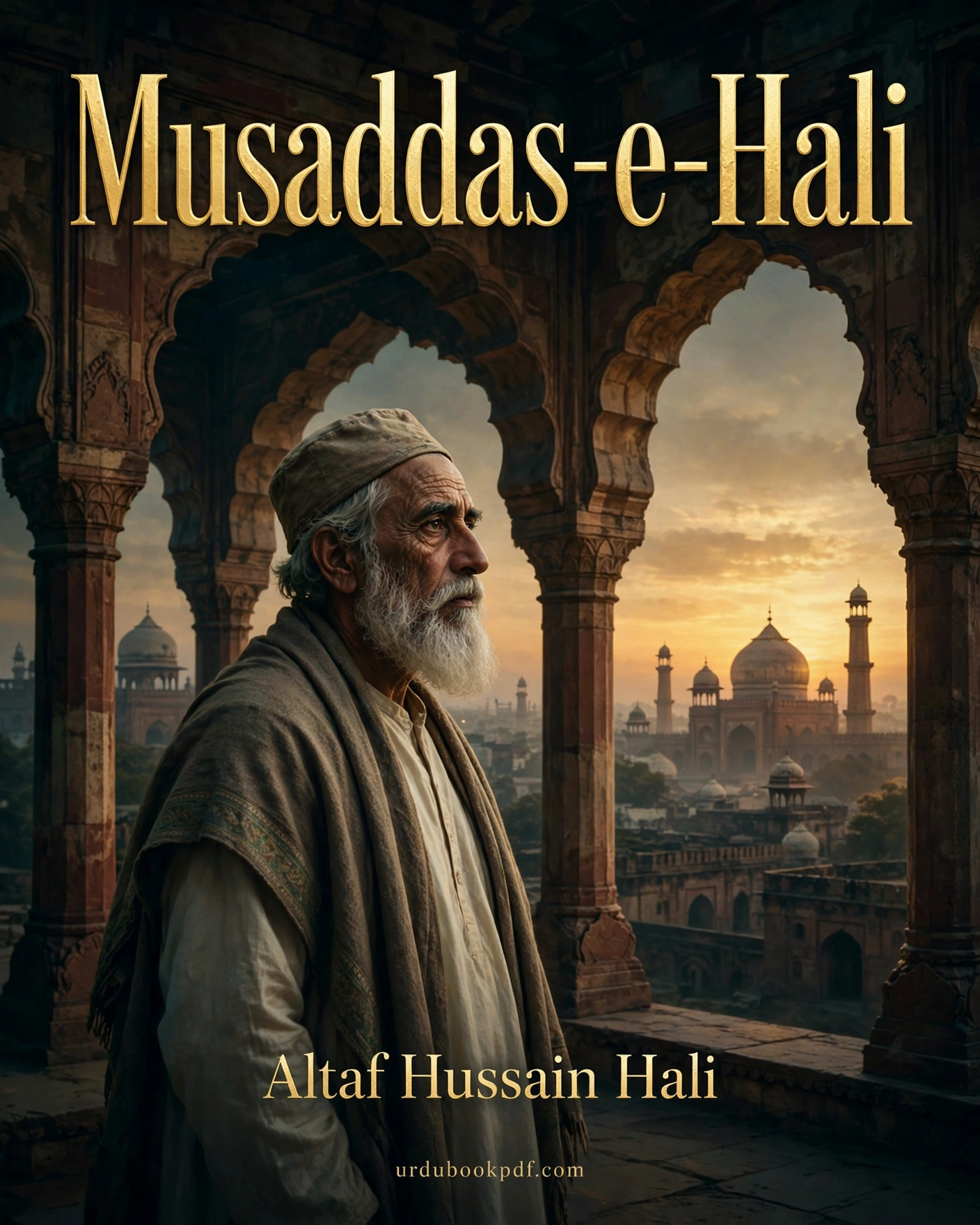
Musaddas-e-Hali by Altaf Hussain Hali is one of the most important long poems in the Urdu language, and this page gives you the complete poem to read online and download as a PDF, together with an honest guide to what it actually is, why it was written, and why it still matters today.
Before you download anything, one fact matters more than any other.
This is not a novel.
There is no hero waiting in the next chapter, no heroine, no love story, and no plot twist to spoil.
Musaddas-e-Hali is a long Urdu poem, written in the musaddas verse form, and it speaks to a whole community rather than to the fate of one fictional character.
This page therefore tells it plainly, right at the start.
The poem’s full title is Madd-o-Jazr-e-Islam, which means the ebb and flow of Islam.
First published in 1879, it has been read, recited, and taught ever since across the Urdu-speaking world.
Its subject is the rise and decline of Muslims: the greatness of their past, the weakness of their present in Hali’s own time, and a passionate call to wake up, learn, reform, and rise again.
Quick Answer: Musaddas-e-Hali by Altaf Hussain Hali is a complete long Urdu poem, not a novel, first published in 1879. Its full title is Madd-o-Jazr-e-Islam, the ebb and flow of Islam. It recalls the glorious past of Muslims, mourns their decline, and calls them to education, reform, and self-respect. Read it online or download the complete PDF using the buttons below.
Key Facts
- Form: a long Urdu poem in the musaddas form, not a novel and not a story.
- Full title: Madd-o-Jazr-e-Islam, meaning the ebb and flow of Islam.
- Author: Altaf Hussain Hali (1837 to 1914), Urdu poet, critic, and reformer.
- First published: 1879, at the request of Sir Syed Ahmad Khan.
- Theme: the rise and decline of Muslims, and a call to reform and awakening.
- Characters: none, because it is a poem addressed to a community, not a story about people.
- Language: Urdu, in a famously simple and direct style.
- Availability: complete PDF download and read online on this page.
| Book Name | Musaddas-e-Hali |
| Full Title | Madd-o-Jazr-e-Islam (The Ebb and Flow of Islam) |
| Author / Writer Name | Altaf Hussain Hali |
| Form / Genre | Long Urdu poem in musaddas form (not a novel) |
| First Published | 1879 |
| Written At The Request Of | Sir Syed Ahmad Khan |
| Language | Urdu |
| Theme | Rise and decline of Muslims, reform, education, awakening |
| Also Searched As | Musaddas-e-Haali, Musaddas Madd-o-Jazr-e-Islam, Madd-o-Jazr-e-Islam |
| Status | Complete poem |
| Availability | Free PDF Download and Read Online |
✅ Complete PDF Download
Musaddas-e-Hali by Altaf Hussain Hali: What This Poem Really Is
The first thing to understand about Musaddas-e-Hali is what kind of writing it is, because most download pages get this wrong.
It is filed on many websites under Urdu novels, and readers arrive expecting chapters, characters, and a story.
That expectation leads to disappointment, and the disappointment is not the poem’s fault.
It is the fault of a wrong label.
Musaddas-e-Hali is a poem, and a very long one, built from stanza after stanza in the musaddas form.
In this form, each stanza, each band, is made of six lines, and the poem moves forward not through events but through thought, feeling, and argument.
There is no hero and no heroine.
There is no villain, no wedding, no separation, and no reunion.
The poem’s speaker is not a character in a story.
He is a voice speaking to his own people, sometimes praising them, sometimes rebuking them, and always urging them to change.
Like Dil Darya Samandar by Wasif Ali Wasif, which is also wrongly filed as a novel on many sites although it is a book of reflections, Musaddas-e-Hali rewards readers who meet it on its own terms.
The word musaddas itself tells you the shape of the poem.
It comes from the Arabic word for six, and it names a stanza of six lines.
Classical Urdu poets used this form for elegies and long serious poems, and Hali chose it deliberately for a serious subject.
A musaddas is long, steady, and public, and it suits history, lament, and a call to action.
Hali needed room to look back over centuries, to describe a present he found painful, and to argue for a different future.
Only a long form could hold all three movements, and the musaddas gave him that room.
The Full Title: Madd-o-Jazr-e-Islam, The Ebb and Flow of Islam
Most readers know the poem by its short name, Musaddas-e-Hali, which simply means Hali’s musaddas.
Its full title is Madd-o-Jazr-e-Islam.
Madd means the rising tide, and jazr means the ebb, the tide going out.
Put together, the title is a picture of history itself: no community stays at high tide forever, and no community stays at low tide forever either.
Hali’s poem is built on that image from start to finish.
It remembers the high tide, when Muslim civilisation led the world in learning, justice, courage, and art.
It mourns the low tide, when that same community had lost power, confidence, and direction.
And it insists that tides turn again, but only for people willing to change themselves.
A lament only looks backward and weeps.
This poem looks backward, looks around, and then looks forward, and its last movement is an appeal, not a funeral.
Why Hali Wrote It: Sir Syed Ahmad Khan and the Time After 1857
Musaddas-e-Hali was not written by accident, and it was not written for fame.
It was written at the request of Sir Syed Ahmad Khan, the great reformer and founder of the Aligarh movement.
Sir Syed believed that the Muslims of India, after the uprising of 1857 and the fall of Mughal power, were in danger of sinking into despair, anger, and refusal to learn.
He wanted a poem that would do what speeches and essays could not do: reach the heart, make people feel their loss honestly, and then turn that feeling into a will to reform.
He asked Hali to write it, and Hali answered with the Musaddas.
When Sir Syed read it, he praised it in the highest terms, and he is reported to have said that getting Hali to write the Musaddas was the deed he would be proudest to present.
The time matters, because the poem cannot be understood without it.
The Mughal Empire, which had ruled India for centuries, was finished in all but name.
Delhi, once the centre of Muslim learning and culture, had been shattered by the events of 1857 and their aftermath.
Hali wrote into that mood, and he did not flatter it.
He told his readers plainly that their condition was the result of their own neglect, their love of ease, their quarrels, and their abandonment of learning and honest work.
That honesty is what makes the poem uncomfortable, and it is also what makes it great.
Readers who enjoy seeing a writer hold a mirror up to society will find a kindred spirit in Manto Nama by Saadat Hasan Manto, although Manto’s mirror was held up to a very different age and in a very different form.
What the Poem Covers: Past Glory, Present Decline, and a Call to Rise
The poem moves in three great arcs, and knowing them in advance makes reading far easier.
The first arc looks back at the past.
It recalls the early Muslims and the civilisation they built: their faith, their courage, their learning, their justice, and their service to humanity.
Hali describes this past not as dry history but as a living memory, full of pride and warmth.
The point is to remind readers what their community once stood for, so that the contrast with the present hits harder.
The second arc turns to the present, and it is unsparing.
Hali describes a community that has grown lazy, divided, fond of show, and afraid of hard work.
He speaks of neglected education, empty pride, quarrels over small things, and a religion reduced to outward forms while its inner spirit is forgotten.
Hali does not blame outsiders alone.
He insists that decline has inward causes, and that naming those causes honestly is the first step toward recovery.
That is a hard message, but it is also a hopeful one, because inward causes can be changed by inward effort.
The third arc is the appeal.
Hali urges his readers to return to learning, to honest work, to unity, to simplicity, and to the true spirit of their faith.
He calls on the young to study, on the rich to spend wisely, on scholars to guide, and on ordinary people to take responsibility for their own future.
The poem ends not in despair but in a summons.
The theme of a community facing its own decline also runs through Aangan by Khadija Mastoor, Khadija Mastoor’s great novel of Muslim society in the years around Partition, although Aangan tells its story through characters and a household, where Hali speaks directly to his people.
One note belongs here: this page describes the poem’s themes at a general level on purpose, and it does not reproduce the poem’s text in detail.
Readers who want the verses themselves should read the complete book through the buttons on this page, because no summary can carry the music and force of Hali’s verse.
The Shape of the Poem: Stanzas, the Zamima, and Different Editions
Readers often ask how long the poem is, and the answer needs a little care, because different editions count differently.
The original Musaddas is commonly cited as containing about 293 six-line stanzas, which works out to roughly nine hundred lines of verse in the couplet count used by many listings.
Later, Hali added a supplement, the Zamima, which is commonly cited at about 161 further stanzas.
Some editions also carry a separate address section, the Arz-e-Hal, cited at about 63 stanzas.
These figures are the ones most often repeated in descriptions of the poem, but editions vary in layout, in what they include, and in how they number the stanzas.
That is why this page does not promise one fixed page count, and why the buttons here point to the complete poem rather than to a selection of famous lines.
The poem’s language is another reason for its fame.
Hali wrote in simple, clear Urdu, avoiding the heavy ornament and wordplay that made much classical poetry hard for ordinary readers.
He believed that a poem meant to reform a community must be understood by that community, and he practised what he preached.
The historical sweep of the poem finds a prose counterpart in Khaak aur Khoon by Naseem Hijazi, Naseem Hijazi’s novel of the freedom struggle, which likewise asks what a community gains and loses in times of upheaval, though it does so through story rather than verse.
Why Musaddas-e-Hali Changed Urdu Poetry Forever
Before Hali, much of Urdu poetry was devoted to love, beauty, and the pleasures of refined language.
That poetry was beautiful, but it had little to say to a community in crisis.
Hali changed the subject of poetry itself.
He showed that a poem could discuss history, society, education, and reform, and still be a poem, still move its readers, and still be beautiful.
Critics often say that the modern age of Urdu poetry begins with the Musaddas, and Sir Syed is reported to have said something very close to that when the poem first appeared.
The great Iqbal, who came a generation later, carried that purposeful path further than anyone.
Hali’s criticism carried the same message as his poetry.
His Muqaddama-e-Shair-o-Shairi, the introduction to his collected poems, is one of the earliest works of literary criticism in Urdu.
In it, he argued that poetry should be sincere, natural, and useful, that it should describe real life and real feeling, and that empty ornament was a weakness, not a strength.
They gave younger poets permission to write simply and seriously, and they gave readers a standard by which to judge new poetry.
That is why Hali matters twice over: once as a poet, and once as a critic who changed what poetry was allowed to be.
Altaf Hussain Hali: The Poet Behind the Poem
Altaf Hussain Hali was born in 1837 in Panipat, and he died in 1914.
His life spans the most turbulent century in modern Indian history, from the last years of Mughal rule to the age of reform movements, new education, and political awakening.
He began as a traditional poet, writing ghazals in the classical manner, and he learned his craft in Delhi, where he came under the influence of the great Ghalib and of Shefta, two towering figures of Urdu poetry.
He took the pen name Hali, which means the contemporary, the man of the present age, and the name itself was a programme: he wanted to be a poet of his own time, speaking to its problems, not a poet lost in the past.
Hali was far more than the author of one poem, although the Musaddas alone would have secured his fame.
He wrote biographies that remain standard sources to this day: Yaadgar-e-Ghalib, his life of Ghalib, Hayat-e-Saadi, his life of the Persian poet Saadi, and Hayat-e-Javed, his life of Sir Syed Ahmad Khan.
He worked as a teacher and a reformer as well as a writer, and his whole life shows a single thread: a belief that knowledge, sincerity, and hard work are the way forward for individuals and for communities alike.
He was not a distant scholar writing about other people’s troubles.
He lived through the decline he describes, he knew the Delhi he mourns, and he worked, alongside Sir Syed, for the reform he urges.
Readers who want a lighter classic after Hali’s serious verse often turn to Zarguzasht by Mushtaq Ahmad Yousufi, Mushtaq Ahmad Yousufi’s beloved book of humour and satire, which shows a very different Urdu genius at work.
How to Read Musaddas-e-Hali: A Practical Guide
A long poem needs a different reading method from a novel, and a little planning will make the experience far better.
Do not try to finish it in one sitting, as you might finish a short story.
Read a few stanzas at a time, slowly, and aloud if you can.
Urdu poetry is meant to be heard as well as read, and the sound of the lines carries much of their feeling.
After each group of stanzas, pause and ask yourself what Hali is saying, and whether his description fits the world you see around you.
Read with a pencil or a notebook nearby, and note the lines that strike you and the passages you find difficult.
School editions with word meanings are genuinely useful for this poem, and even experienced readers keep a commentary nearby, because Hali’s Urdu belongs to another century and some words have changed their shade of meaning since his time.
Who Should Read Musaddas-e-Hali?
Students of Urdu literature should read it first, because no course on Urdu poetry is complete without it, and examiners return to it again and again.
Readers interested in the history of Muslims in India should read it, because it is a primary voice from the age it describes, not a later historian’s account.
And general readers should read it too, because its theme, the rise and fall of communities and the power of reform, belongs to no single age or nation.
If you want a love story, this is not your book, and you will be happier with a novel.
But if you want a work that will stay with you, that you will quote years later, and that will change how you see your own community and your own responsibilities, then few Urdu books will reward you more.
Readers drawn to Islamic themes and the life to come may also wish to read Jab Zindagi Shuru Hogi by Abu Yahya, a modern Islamic novel that approaches faith and accountability through story, offering a useful contrast with Hali’s direct poetic address.
Musaddas-e-Hali PDF Download and Read Online
This page gives you the complete Musaddas-e-Hali by Altaf Hussain Hali to read online and to download as a PDF.
Use the Read Online button if you want to start reading at once, and use the Download PDF button if you want to keep the poem on your phone or computer for slow reading over many days.
Both buttons point to the same complete file supplied for this page, so choose whichever suits your reading habit.
The file is the complete poem, not a selection of famous lines.
If you are a general reader, any complete edition will serve you well, and the best edition is the one you will actually read, slowly and to the end.
Frequently Asked Questions About Musaddas-e-Hali
Is Musaddas-e-Hali a novel?
No, it is not a novel.
It is a long Urdu poem in the musaddas form, and it has no plot, no hero, no heroine, and no fictional characters.
Websites that file it under novels are using the wrong label, and this page corrects that label plainly.
What is the full title of Musaddas-e-Hali?
The full title is Madd-o-Jazr-e-Islam, which means the ebb and flow of Islam.
Musaddas-e-Hali is the short, popular name, meaning Hali’s musaddas.
Both names refer to the same poem by Altaf Hussain Hali.
Who wrote Musaddas-e-Hali and when was it published?
It was written by Altaf Hussain Hali, and it was first published in 1879.
Hali wrote it at the request of Sir Syed Ahmad Khan, who wanted a poem that would awaken Muslims to reform after the decline of Mughal power and the events of 1857.
What is Musaddas-e-Hali about?
At theme level, it is about the rise and decline of Muslims.
It recalls their glorious past, mourns their present weakness in Hali’s time, and calls them to education, honest work, unity, and reform.
Its central image is the tide, which ebbs and flows, and which can rise again.
What is the musaddas form of poetry?
A musaddas is a stanza of six lines.
The form suits long, serious poems, because it gives the poet room to develop history, argument, and feeling at length.
Hali chose it deliberately for a public poem addressed to a whole community.
How long is Musaddas-e-Hali?
The original poem is commonly cited at about 293 six-line stanzas.
Hali later added a supplement, the Zamima, commonly cited at about 161 further stanzas.
Different editions vary in what they include and in page count, so a different page number does not mean a different poem.
Does Musaddas-e-Hali have a hero or a love story?
No, it has neither.
It is addressed to a community, not built around characters, and its emotion comes from history, lament, and appeal, not from romance.
Why is Musaddas-e-Hali so famous?
Because it changed Urdu poetry.
It showed that poetry could discuss history and reform and still move its readers deeply, and it is widely regarded as marking the beginning of the modern age of Urdu poetry.
Its simple language, its honest criticism, and its hopeful ending made it a living classic, still taught and recited today.
How can I read Musaddas-e-Hali online or download the complete PDF?
Use the Read Online and Download PDF buttons on this page.
They point to the complete poem supplied for this page.
Read a few stanzas at a time, aloud if you can, and keep a notebook for lines and ideas that strike you.
What should I read after Musaddas-e-Hali?
Read Hali’s Muqaddama-e-Shair-o-Shairi for his ideas on poetry, and his Yaadgar-e-Ghalib for his prose at its finest.
Then follow the line forward to Iqbal, who carried purposeful Urdu poetry further than anyone.
For a different kind of classic, a novel of Muslim society in a later age, Aangan by Khadija Mastoor is a natural next step.
Final Verdict: Should You Read Musaddas-e-Hali?
Musaddas-e-Hali by Altaf Hussain Hali earns its place among the greatest works of Urdu literature not by telling a story but by telling a community the truth about itself.
It asks for patience, for honesty, and for a willingness to hear an unwelcome message followed by a hopeful one.
Read it slowly, a few stanzas a day, and let each movement do its work before you move to the next.
That is how its readers have always read it, and that is why it is still being read, taught, and quoted nearly a century and a half after it first appeared.
Read the complete poem online or download the complete PDF using the buttons on this page, and begin with an open mind and a notebook nearby.
You will not find a hero or a love story here.
You will find something rarer: a poem that tried to wake a people, and that still has the power to wake its readers today.
✅ Complete PDF Download